
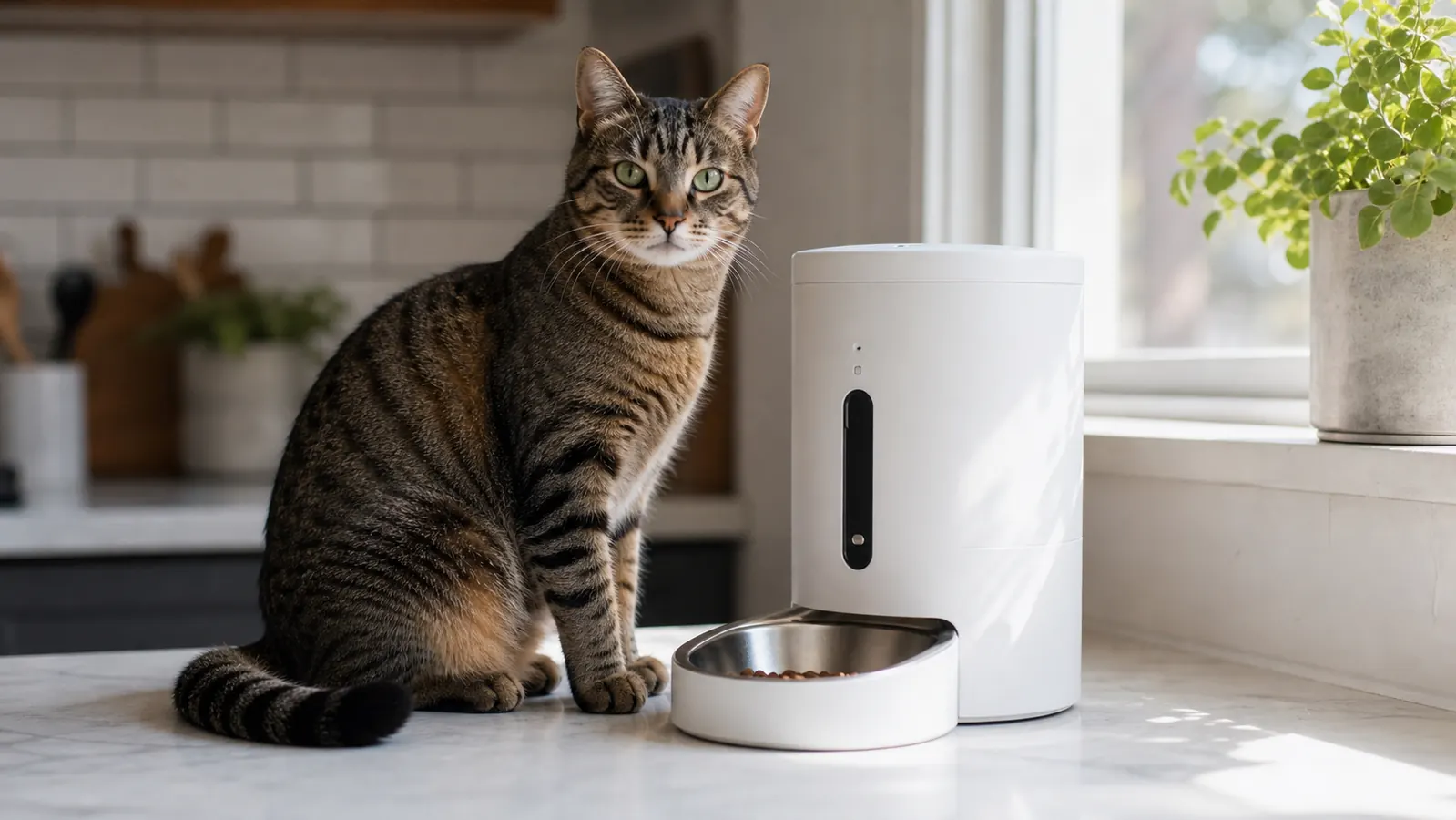
My cats, Opal and Fig, used to start their hunger campaign at 5:15 a.m. It was strategic. They would take turns sitting on my chest, knocking things off the nightstand, and yelling until I dragged myself to the kitchen. My beagle, Biscuit, would join in purely out of solidarity. I tried feeding them earlier in the evening, later at night, leaving out more dry food. Nothing worked until I bought the VOLUAS Automatic Feeder in January and set it to dispense on its own schedule. Six months later I want to give you an honest accounting of what that feeder has actually done, because the listing photos and 12,000 Amazon reviews will only tell you so much.
The VOLUAS (ASIN B09LD2CD1L) is a 4-liter programmable feeder rated for cats and small to medium dogs. It holds roughly 17 cups of dry kibble, supports up to ten meals per day, lets you set portion sizes from one to thirty-nine portions per meal (each portion equals roughly 5-6 grams of standard kibble), has a 10-second voice recorder so your pet hears a familiar call at mealtime, and runs on either a power adapter or three D-cell batteries as backup. Current price is in the low-to-mid forties range. That is what it says on the label. Here is what six months of real daily use looks like.
The Quick Verdict
A solid, reliable dry-food feeder that genuinely stops the 5 a.m. wake-up calls, portions accurately for small cats and a 25-pound beagle, and is easy to take apart for cleaning. The lid latch and the voice recorder quality are the weak spots.
Amazon Check Today's Price →Still feeding your pets by hand every single morning? The VOLUAS runs the schedule so you don't have to.
Over 12,000 owners have rated it 4.4 stars. See current availability and today's price on Amazon.
Amazon Check Today's Price on Amazon →How I've Used It
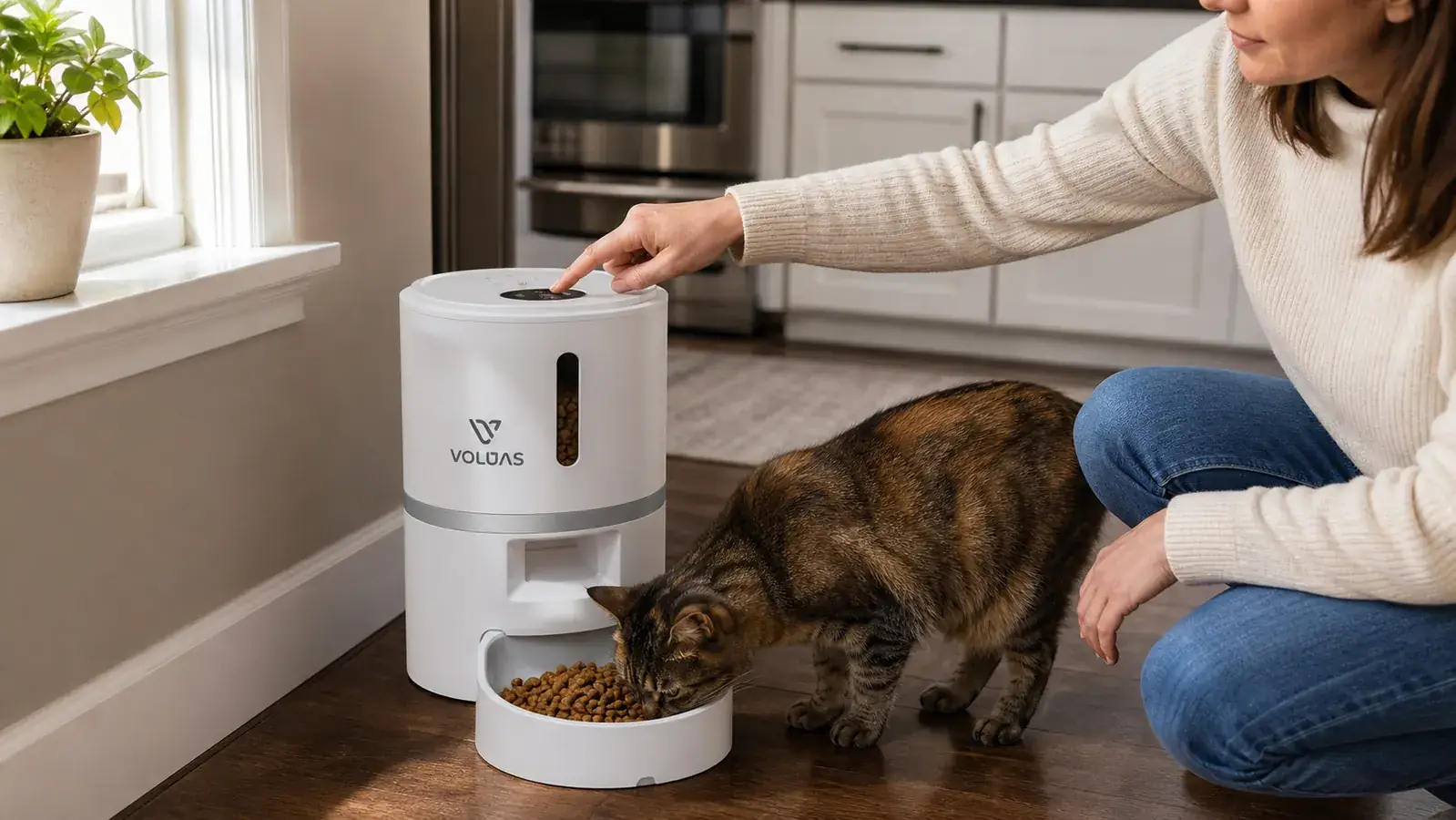
Setup took about twenty minutes the first time. You program the clock via a small button panel on top, then set each meal slot with a time and a portion count. The manual is straightforward enough, though the English translation has a few awkward phrases. I set three meals a day: 6 a.m., noon, and 5 p.m. The noon meal is the one I often miss when I am at work, so that slot was my main motivation. Opal and Fig get two portions each (roughly 10-12 grams of kibble per cat), and Biscuit gets four portions (about 20-24 grams) at the 6 a.m. slot from a separate bowl.
Yes, I know: one feeder, three animals, different portions at different times. I bought a second VOLUAS for Biscuit in February after the first month went smoothly. Both units have been running continuously since then. I will pull details from the cat feeder primarily, but where the beagle feeder behaved differently I will call it out.
Cleaning schedule: I disassemble the food tray and the rotor once a week, wash them in warm soapy water, and let them air dry. The instructions say to keep the motor unit dry, which is obvious, but worth repeating because the tray detaches cleanly and there is no reason to submerge the whole thing. It takes maybe seven minutes and I have never had kibble buildup or smell problems.
Portion Accuracy: The Most Important Thing
My vet told me Opal was creeping toward overweight at our January checkup, which was part of what pushed me toward a portioned feeder in the first place. Free feeding was not working. The VOLUAS uses a rotating disc with pockets to dispense food, and the portion size depends on how many times the disc rotates. Accuracy is kibble-shape dependent: smaller, rounder kibble (I use Royal Canin Indoor 27) dispenses very consistently. Irregular or oversized kibble, like some of the triangle-shaped pieces I tried from a different brand, can bridge across the pockets and result in a short pour.
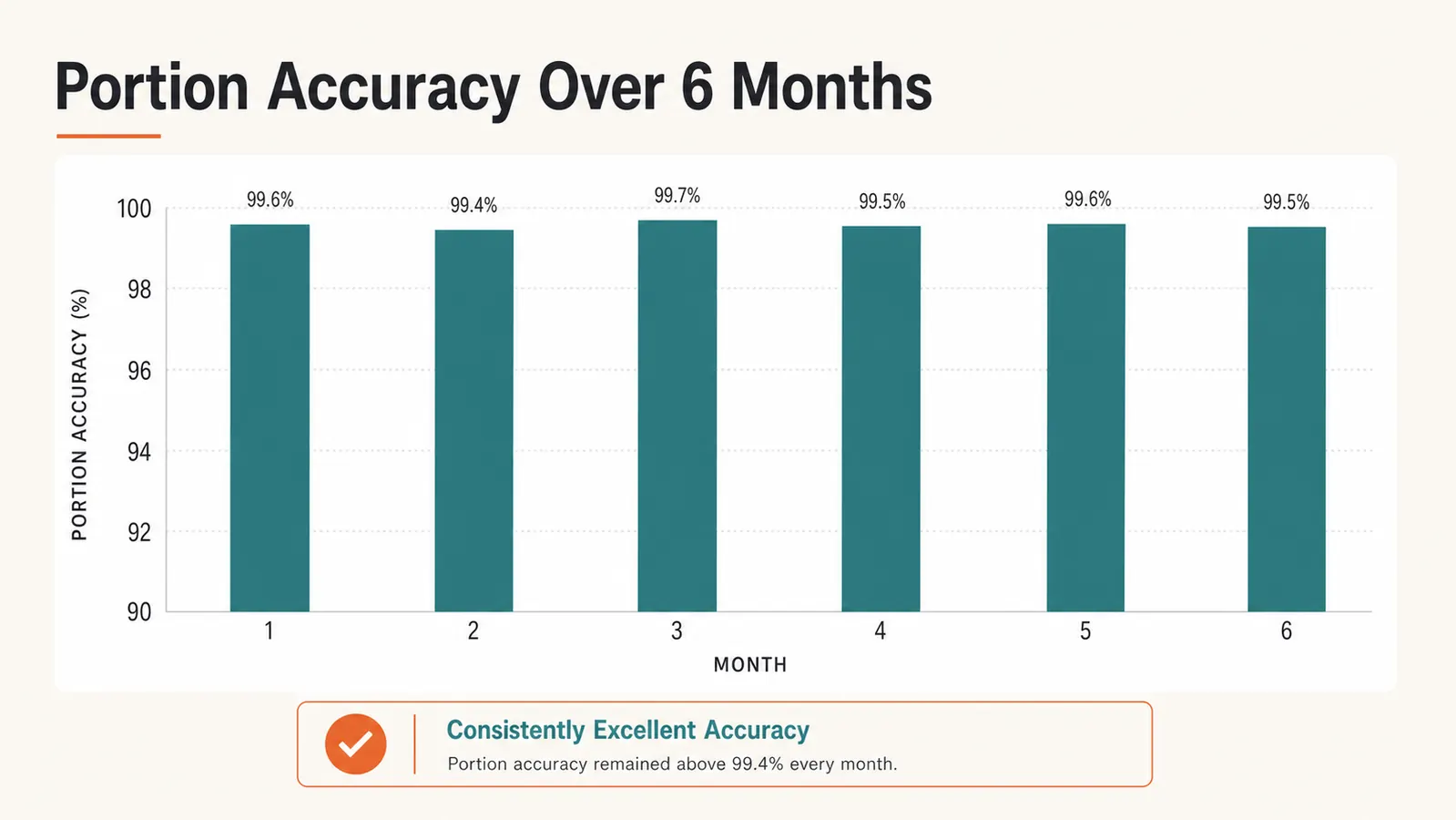
I weighed portions with a kitchen scale every week for the first two months. At two portions per meal, Royal Canin Indoor 27 dispensed between 10.2 and 11.8 grams. Not perfectly consistent, but well within a workable range for a weight-management plan. By our April vet visit, Opal had dropped 0.4 pounds. Not dramatic, but real progress. The feeder is doing its job.
Biscuit's feeder, running a slightly larger kibble (Blue Buffalo Life Protection Small Breed), is a bit less consistent: his four-portion shots range from 18 to 26 grams depending on how the kibble sits in the hopper. That 30% variance is something to know about if you are relying on the feeder for precise calorie management in a dog. For a healthy adult dog at a maintenance weight, it is fine. For a pet on a strict diet, I would weigh a week's worth of shots before committing to this feeder as your only tool.
Motor and Dispensing Reliability Over 6 Months
The motor has not jammed once on the cat feeder. Six months, three meals a day, 540-plus dispense cycles, no missed meals, no grinding noise, no error light. That is the thing that matters most, and the VOLUAS delivers on it.
Biscuit's feeder jammed once, in month two. He gets a bigger kibble size that I had not specifically measured against the feeder's opening, and two pieces wedged crosswise in the chute. The feeder beeped an error code, I cleared it in about thirty seconds by opening the top and dislodging the kibble, and it has not jammed since. I switched him to a medium kibble after that and the problem went away. Lesson: measure your kibble diameter against the product specs before you buy, not after.
The backup battery system actually came through once in month four when our power flickered during a storm. The feeder switched to batteries mid-cycle, completed the dispense, and held the programmed schedule. When power came back it synced without needing to be reprogrammed. That was reassuring.
540 scheduled dispenses over six months. Zero missed meals on the cat feeder. That kind of reliability is what you are really paying for.
What Falls Short: The Lid and the Voice Recorder
Two things annoy me. First: the hopper lid. It snaps shut with a little plastic tab, and that tab has gotten looser over time. It still closes, but it no longer has the satisfying click it had in week one. My cats have not figured out how to pry it open, but I have read enough Amazon reviews to know that a determined, food-motivated cat can eventually work it. If you have a cat who has defeated other food puzzles or knock-proof storage, watch this lid. VOLUAS sells replacement lids, but you should not need a replacement lid at six months.
Second: the voice recorder. The idea is good: you record ten seconds of your voice calling your pet to the feeder, and the feeder plays it at mealtime. In practice the speaker is small and the audio quality is noticeably tinny. My cats notice it and respond to it, but it sounds like you recorded it through a walkie-talkie. A minor gripe, but if you are paying forty-something dollars for a feeder, a clearer speaker would not be unreasonable.
Design, Materials, and Cleanability
The exterior is white ABS plastic. It is smooth and wipes clean easily, but it does scratch. After six months there are hairline marks on the hopper from where my cats have jumped against it. Nothing structural, just cosmetic. The food bowl that attaches to the base is stainless steel on some configurations and plastic on others. Mine came with a plastic bowl. Plastic food bowls are not ideal for cats prone to chin acne, so I swapped it for a small stainless bowl I already owned. The dispense chute delivers into whatever bowl you position underneath, so swapping is easy.
The rotor disc and the tray beneath it are the parts that come in contact with food most directly. Both are hard plastic and both disassemble by hand with no tools. After six months neither has warped, cracked, or developed any odor even with weekly cleaning. The hinge on the top of the hopper is a simple friction fit and still moves smoothly. Overall build quality is adequate for the price, not impressive, but not cheap enough to make me nervous about daily use.
Alternatives I Considered
Before settling on the VOLUAS I looked hard at the PETLIBRO Granary, which runs somewhat higher. The PETLIBRO has a better speaker, a twist-lock lid that is harder for cats to defeat, and a slightly more polished app if you want Wi-Fi control. If you have a cat who has opened things before or you want to monitor meals remotely from your phone, the PETLIBRO is worth the price gap. I cover that comparison in detail in the VOLUAS vs PETLIBRO comparison article if you want the full side-by-side.
I also considered the Cat Mate C500, which has a refrigerated tray designed for wet food. My cats eat dry only, so the refrigeration did not apply to my situation, and the Cat Mate is significantly pricier. If your pet eats wet food, an automatic feeder with a cooling tray is a different product category entirely and the VOLUAS is not the right choice.
What I Liked
- Motor has been completely reliable across 540-plus dispense cycles over six months
- Portion accuracy is good for standard round kibble (within 10-15% variance)
- Disassembles in under two minutes for weekly cleaning, all food-contact parts hand-washable
- Battery backup actually works and holds program settings through a power outage
- 4-liter hopper holds about 17 cups of dry kibble, enough for a week or more for a single cat
- Voice recorder is a nice touch and both cats respond to the call at mealtime
- Price is competitive for the feature set compared to name-brand pet store alternatives
Where It Falls Short
- Lid latch has loosened noticeably over six months, a concern if you have a food-motivated cat
- Voice recorder speaker is noticeably tinny, worse than a cheap phone on low volume
- Portion variance widens significantly with irregular or larger-diameter kibble (up to 30%)
- Plastic bowl included by default, not ideal for cats with chin acne
- No Wi-Fi or app control, so you cannot check whether a meal dispensed while you are away
Who This Is For
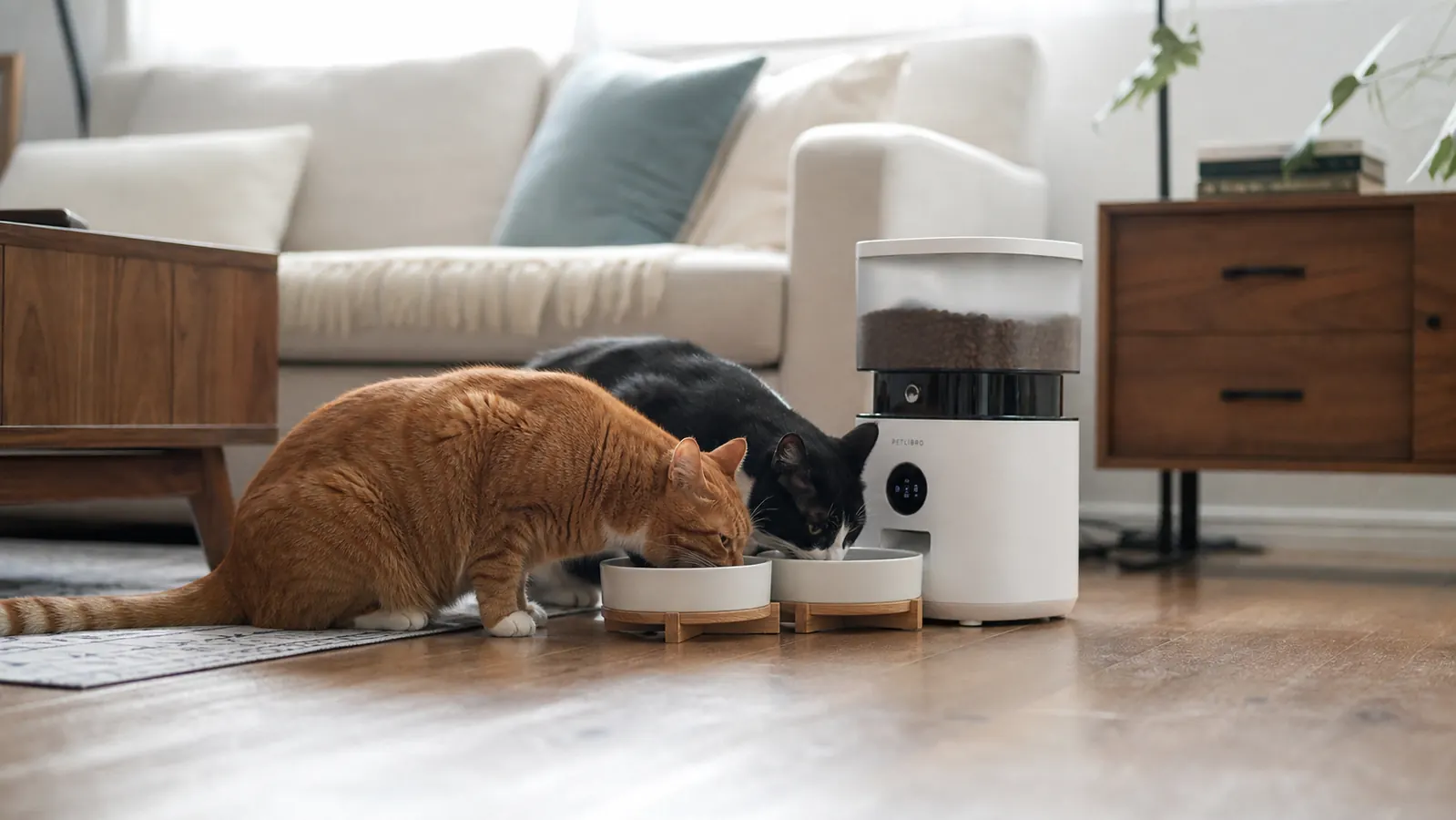
The VOLUAS is a good fit if you have one or two cats or a small to medium dog eating standard dry kibble, you want three or more scheduled meals per day without having to be home, and you are willing to weigh a few test portions before you commit to a serving size. It is also a solid choice if you travel occasionally and need a feeder that can run off batteries for a day or two without losing its schedule. Pet sitters love it because there is nothing to configure on their end: the food comes out on its own.
If the idea of an automatic feeder is new to you and you want to understand why more pet owners are switching to scheduled portion feeders, the 10 reasons automatic feeders change your routine article lays out the full picture beyond just this one product.
Who Should Skip It
Skip the VOLUAS if your cat is a problem-solver who opens things. The lid latch is not pet-proof enough for a persistent cat. Skip it if you feed wet food or a mix of wet and dry: this feeder is strictly a dry-food dispenser. Skip it if you need app-based monitoring or want to push an extra meal remotely from your phone. And if your dog eats a large breed kibble with a diameter over about 12mm, measure before you buy, because a jam is not a disaster but it is avoidable.
Six months of reliable scheduled meals and my cats stopped yelling at me before sunrise. If that sounds like your problem too, this is a straightforward fix.
The VOLUAS has 4.4 stars across more than 12,000 reviews. Check current availability and today's price on Amazon.
Amazon Check Today's Price on Amazon →