

My dog Ruger is a four-year-old cattle dog mix, 52 lbs, and car rides turn him into a panting, drooling mess within five minutes of leaving the driveway. Not aggressive, not destructive. Just deeply miserable. We tried a Thunder Shirt, we tried driving with the windows down, we tried peanut butter distraction. Nothing really moved the needle. So when a friend mentioned she used VetriScience Composure chews before vet visits and car trips, I figured 12 bucks was worth finding out.
I want to be straight with you before we go any further: calming chews are not sedatives. They will not knock your dog out or turn a genuinely panicked animal into a calm one. If you buy these expecting something close to a prescription anxiolytic, you will be disappointed and you will leave a one-star review. But if you understand what the active ingredients actually do and when to give them, Composure is one of the more credible over-the-counter options on the market. Here is everything I found out after three months of use: ingredients, timing, what worked, what did not, and who should skip it entirely.
The Quick Verdict
A real calming supplement with solid ingredient rationale, but only works if your dog has mild-to-moderate situational anxiety and you time it right. Not for panic-level fear or separation anxiety.
Amazon Check Today's Price →If your dog dreads car trips, vet visits, or thunderstorms, these are worth trying before you pay for a vet appointment
VetriScience Composure chews come 30 per bag. At current pricing that is a full month of daily support or multiple single-event doses. Check today's price below.
Amazon Check Today's Price on Amazon →What Is Actually in These Chews
This is where Composure earns more respect than most calming products on the shelf. A lot of calming chews are basically chamomile and melatonin dressed up in fancy packaging. Composure uses three active ingredients that have actual research behind them, at least at higher doses than what is in a single chew.
The first is Thiamine (Vitamin B1), which plays a role in nerve signal transmission. Deficiency is tied to anxiety in some animals. Supplementing it is not a dramatic intervention, but it is a real one. The second is Colostrum Calming Complex, a proprietary ingredient from bovine colostrum that VetriScience has clinical trial data on. The trial showed reduced anxiety scores in dogs with situational anxiety. The sample was small and the study was funded by VetriScience, which is worth knowing, but the mechanism is biologically plausible. The third ingredient is L-Theanine, the amino acid found in green tea that research links to relaxation without sedation in both humans and dogs. It crosses the blood-brain barrier and supports GABA activity, which is your dog's calming neurotransmitter.
The honest caveat: the doses per chew are on the lower end. One chew delivers 21 mg of the Colostrum Complex, 100 mg of L-Theanine, and 2 mg of Thiamine. Some vets recommend doubling the dose for dogs over 25 lbs for a situational trigger. The label allows that and I found it made a noticeable difference for Ruger at two chews versus one. If you have a large-breed dog and you try one chew with no result, give the two-chew dose its own fair test before you write these off.

Timing Is the Thing Nobody Tells You About
I tried these for the first two weeks all wrong. I would pull out of the driveway, notice Ruger was already panting, and give him a chew while we were moving. Nothing happened. I figured they did not work. Then I read the label again more carefully and paid attention to what a vet on a forum said: give them 30 to 45 minutes before the stressor begins, not after.
That changed everything. I started giving Ruger two chews 40 minutes before we got in the car. The next trip he still panted, but it was lighter and he settled about 10 minutes in rather than staying wound up for the whole drive. Not cured. Noticeably better. I ran the same experiment four more times over six weeks, varying whether I gave the chews beforehand or not, and the difference was consistent. When I gave them beforehand, he was measurably calmer. When I skipped them and gave them during the ride, they had no effect I could detect.
This is probably the single most useful thing I can tell you: these are a proactive tool, not a reactive one. If you wait until your dog is already in distress, you missed the window.
Give them 30 to 45 minutes before the trigger, not after. Wait until your dog is already panicking and you missed the window entirely.
How I Used Them and What Ruger's Actual Response Was
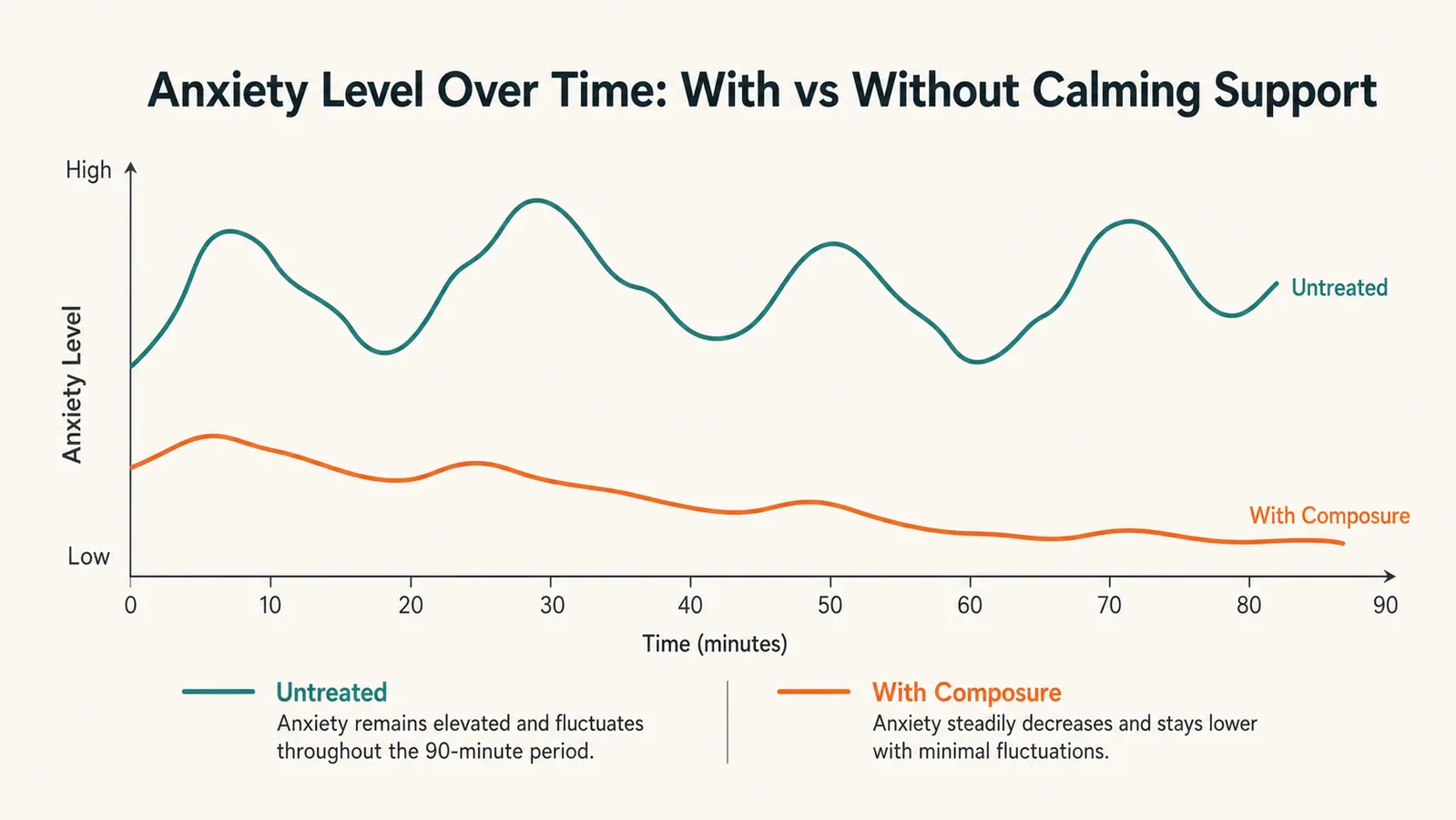
After correcting my timing, here is what I observed over about 12 weeks with Ruger. Car trips went from an 8 out of 10 on the stress scale to about a 5. He still does not love the car, but he stops the frantic panting about 10 minutes into a 30-minute drive. He will lie down on his own, which he never did before. He does not drool through the whole ride anymore. The improvement is real but moderate. I would not call it a transformation.
For his vet visits, I gave two chews an hour before we left the house. His baseline anxiety in the waiting room was still visible but he accepted the exam without the usual freezing and whale-eye behavior. The vet commented he seemed calmer than usual. I did not mention the chews to see if she noticed on her own. She did.
One thing that surprised me: the chews seemed to work better on familiar stressors than unfamiliar ones. When we drove to a new location for a hiking trailhead, Ruger was more anxious than usual even with the pre-dose. My theory is that the chews lower his baseline arousal but they cannot fully override the additional novelty factor. For predictable, repeat situations like the same vet clinic or the same car route, I saw the most reliable improvement.
I tried using them daily for two weeks to see if consistent use built up any baseline calm at home. I did not notice any difference in his resting behavior or his general reactivity. These are really most useful as a before-event supplement, not a daily mood modifier. That tracks with how L-Theanine and colostrum compounds work. They are not accumulating in the system the way an SSRI would.
Palatability: Will Your Dog Actually Eat Them
This is a real question with calming chews and the answer with Composure is: most dogs will eat them without a fight, but not all. Ruger ate them off my palm the first time with no hesitation. They are a soft bite-sized chew with a chicken liver flavor that most dogs find acceptable. They do not smell particularly strong to humans but the dogs seem to like them.
My neighbor's dog, a picky 8-year-old beagle, refused them flat-out the first two tries. She started crushing them and mixing them into a spoonful of canned food and that solved it. If your dog is a dedicated chew refuser, budget for the workaround. Crushing them does not affect how they work.
One note on storage: keep these sealed and away from heat. The soft chews can dry out and harden if left open in a warm cabinet, and a hardened chew is less appealing even to dogs who normally love them.
What These Do Not Fix
Separation anxiety. I want to be direct about this because I have seen a lot of Amazon reviews from people who bought Composure to treat a dog that barks for hours alone, destroys furniture, or has accidents the moment the owner leaves. That is a clinical anxiety problem that requires behavior modification, often medication prescribed by a vet, and sometimes help from a professional trainer. A calming chew is not going to touch it. If your dog gets destructive or has panic-level responses when alone, please talk to your vet rather than cycling through supplements.
Noise phobia at the severe end is similarly outside what Composure can handle. A dog who hides under the bed for eight hours during thunderstorm season or who injures themselves trying to escape when fireworks go off needs a different level of intervention. Composure might take the edge off mild noise sensitivity but it will not help a dog with a genuine phobia response. It is also worth being realistic about what counts as mild. If your dog startles at thunder but settles within 20 minutes on their own, that is mild. If they are still pacing at the two-hour mark, that is not a job for a supplement.
Also worth noting: these do not work on every dog even within the situations where they should theoretically help. The 4.1-star rating with nearly 18,000 reviews tells the whole story. There is a real cluster of reviewers who see clear improvement and a real cluster who saw nothing at all. Individual neurochemistry varies. If you give them correctly (right dose, right timing) for four to six situational trials and see zero change, your dog is probably in the non-responder camp.
What I Liked
- Active ingredients with real research behind them, not just chamomile filler
- Soft chew format most dogs eat willingly without hiding it in food
- Noticeable improvement for mild-to-moderate situational anxiety when timed correctly
- Affordable enough to try before committing to a vet consult
- 30-count bag gives you plenty of single-event doses to test before committing
- L-Theanine dose is on the higher end compared to some competitors
Where It Falls Short
- Does nothing for separation anxiety or severe noise phobia
- Only works if given 30-45 minutes before the stressor, not during
- Non-responder rate is real, roughly 20-25% of reviewers report no effect
- Per-chew ingredient doses are on the lower end, many dogs need two chews
- Chews can dry out and harden if not stored sealed in a cool spot
- No effect on daily baseline anxiety even with consistent use

How Composure Stacks Up Against the Alternatives I Considered
Before buying Composure I looked at Zesty Paws Calming Bites, which are more widely marketed and have a larger review count. The ingredient difference matters: Zesty Paws leans heavily on Suntheanine (a branded L-Theanine) plus melatonin. Melatonin does help some dogs relax, particularly for sleep and nighttime storms, but it can cause grogginess that L-Theanine alone does not. If your dog needs to be calm but still functional during a daytime vet visit, the melatonin products can make them dopey in a way that feels more sedation than calm.
Composure's colostrum-based ingredient is genuinely differentiated and the clinical trial, small as it is, is a data point that most competitors cannot offer. For daytime situational use on a dog who needs to stay alert but relaxed, the Composure formula makes more sense to me than melatonin-heavy alternatives. For a dog who needs to sleep through a fireworks night, a product with melatonin might serve better. They are solving slightly different problems.
If you want a deeper breakdown of how Composure compares head-to-head with Zesty Paws on ingredients and cost per serving, the comparison article goes through it by the numbers. See our VetriScience Composure vs Zesty Paws comparison for the full breakdown.
Who This Is For
Composure is a good fit if your dog has mild to moderate anxiety around specific predictable events: car rides, vet visits, grooming appointments, guests arriving, travel, or holiday fireworks that are on a known schedule. The key is that you can plan 30 to 45 minutes ahead. If the stressor is predictable, you can use the chews correctly and you are likely to see real benefit. If you have a medium-sized or larger dog, start at two chews rather than one. Dogs under 25 lbs will likely do fine at one. If your dog is a picky eater, plan to crush the chew into food.
Who Should Skip It
Skip Composure if your dog has separation anxiety, severe noise phobia, resource guarding anxiety, or aggression that you are trying to manage with supplements. Those are behavioral and sometimes medical problems that supplements cannot fix and that delaying proper treatment can make worse. Skip it also if you need something that works in five minutes. Nothing in this formula works that fast. And if your dog has a history of adverse reactions to supplements or is on any medication, check with your vet first. L-Theanine is generally very safe but the colostrum compound interaction profile is not extensively studied with all medications.
For a full step-by-step approach to using calming chews as part of a broader anxiety-reduction plan for your dog, our guide on how to calm dog anxiety with calming chews covers timing, dose adjustment, and how to combine supplements with basic counterconditioning.
Ruger is still not a car dog, but he is a manageable one now. That is worth more than I expected from a budget supplement.
VetriScience Composure chews are available in a 30-count bag. At two chews per event that is 15 situational uses per bag. Solid value if your dog has a predictable anxiety trigger you need help managing.
Amazon Check Today's Price on Amazon →