

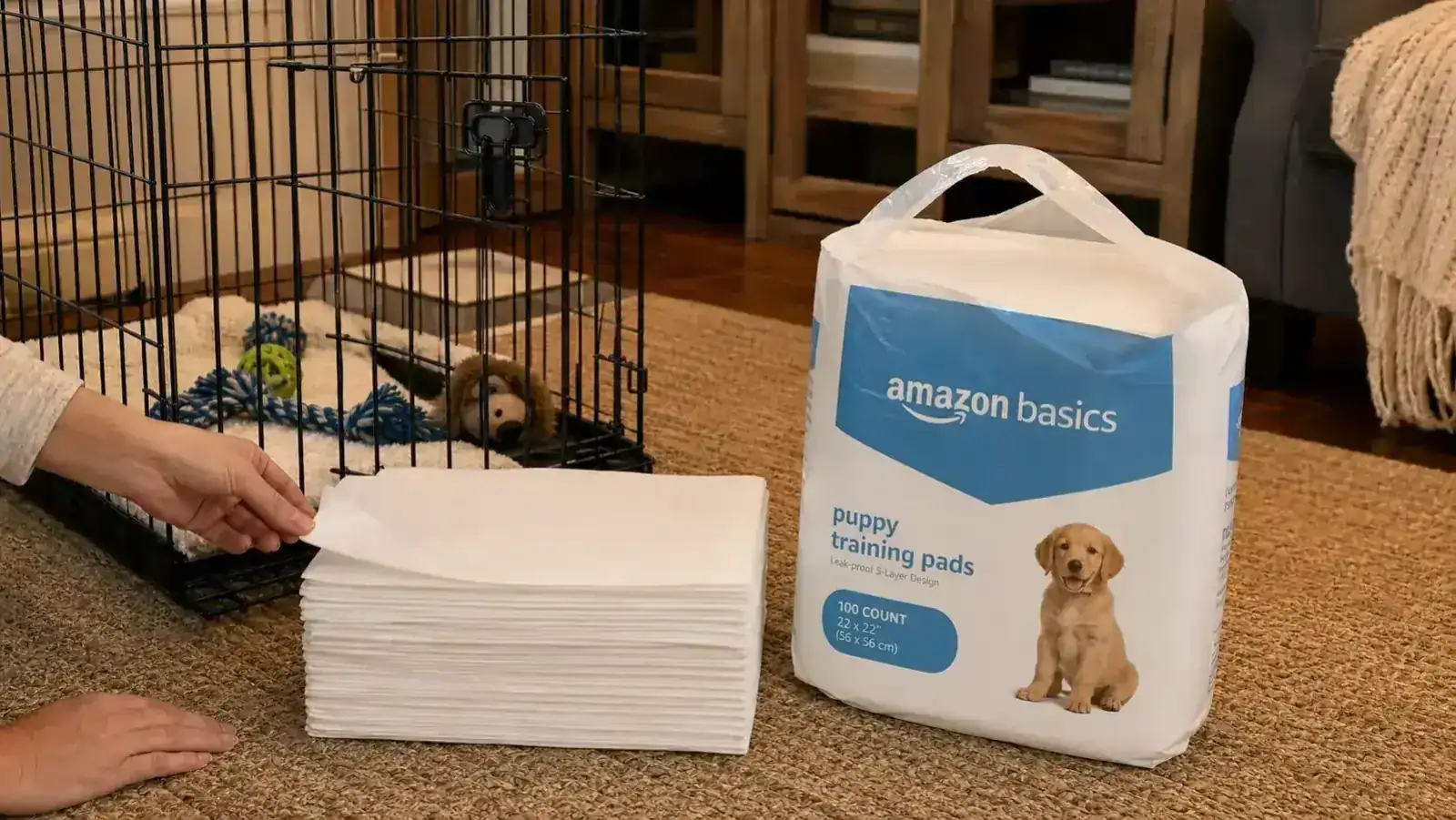
We brought home Biscuit, a 14-week-old Beagle mix, on a Saturday morning in early February. By Sunday afternoon I had already soaked through two bath towels, mopped up four puddles from the kitchen floor, and ordered the largest box of Amazon Basics Super Absorbent Puppy Pads I could find. That box lasted nine days. We are now four months in, well past the initial chaos, and I have used enough of these pads to have an actual opinion.
If you are in the market for puppy pads and wondering whether the Amazon Basics version holds up or whether you should pay more for a premium brand, I have run this experiment so you do not have to. Short answer: they are genuinely good. Longer answer follows.
The Quick Verdict
Reliable absorbency, solid leak protection for the price, and a cost-per-pad that beats most alternatives at volume. A few edge cases where a very large or very active puppy can scoot a pad out of position, but for everyday potty training they do the job.
Amazon Check Today's Price →Your floors are not going to clean themselves. Check the current price on Amazon and grab a bulk box before your next puddle.
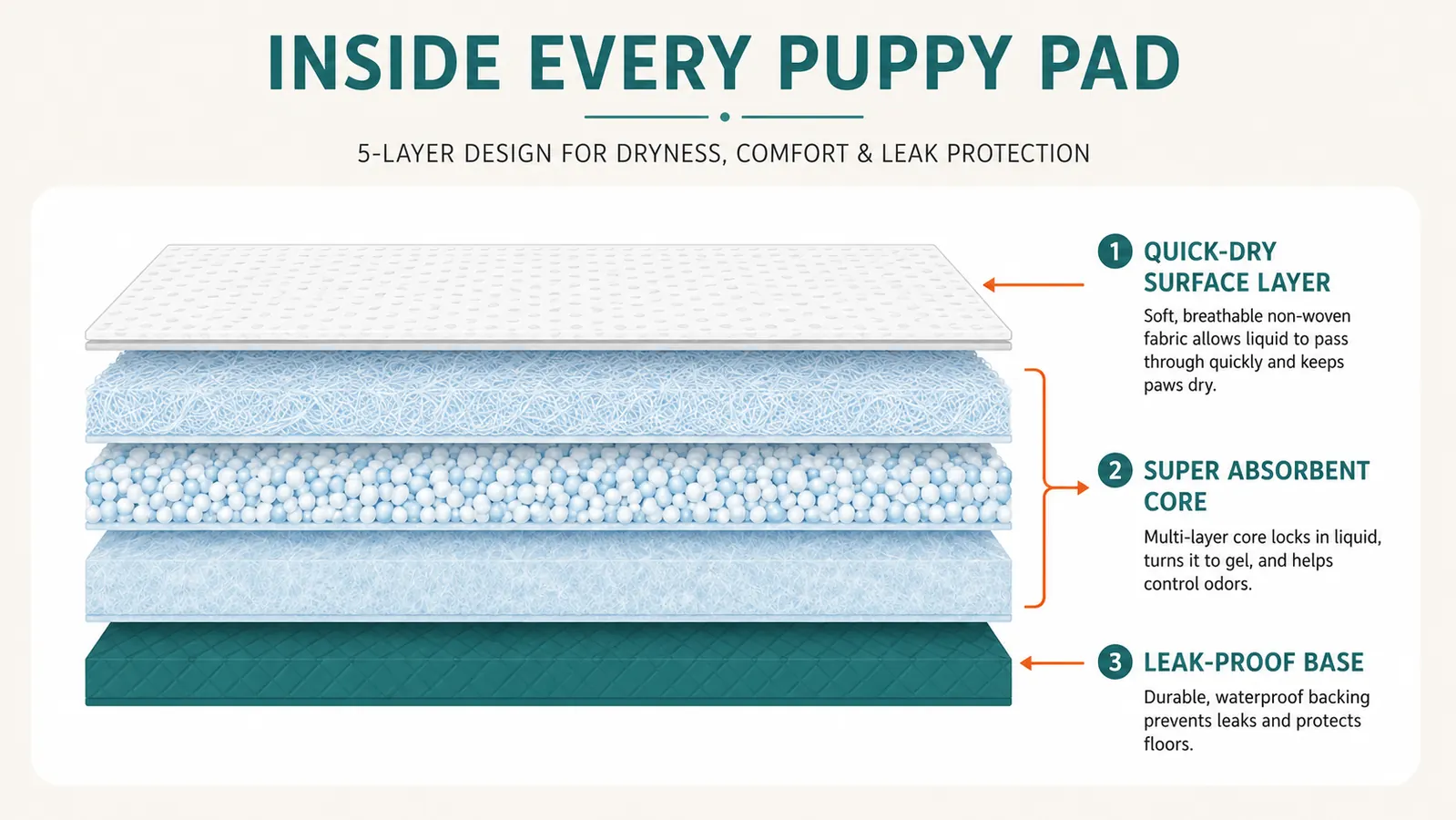
Amazon Basics Super Absorbent Puppy Pads have a 5-layer construction, a quick-dry surface, and a leak-proof base. Over 43,000 reviews back up what four months of daily use confirmed.
Amazon Check Today's Price on Amazon →How I've Used Them: Four Months, One Very Determined Beagle
Biscuit weighed 9 pounds when we brought him home. He is 22 pounds now. That size change matters because the pad that worked great at 9 pounds gets tested differently by a 22-pound dog with a much larger bladder capacity. I track this not because I am obsessive but because I needed to figure out when to size up, and I wanted to know if the absorbency claims actually held across different volumes.
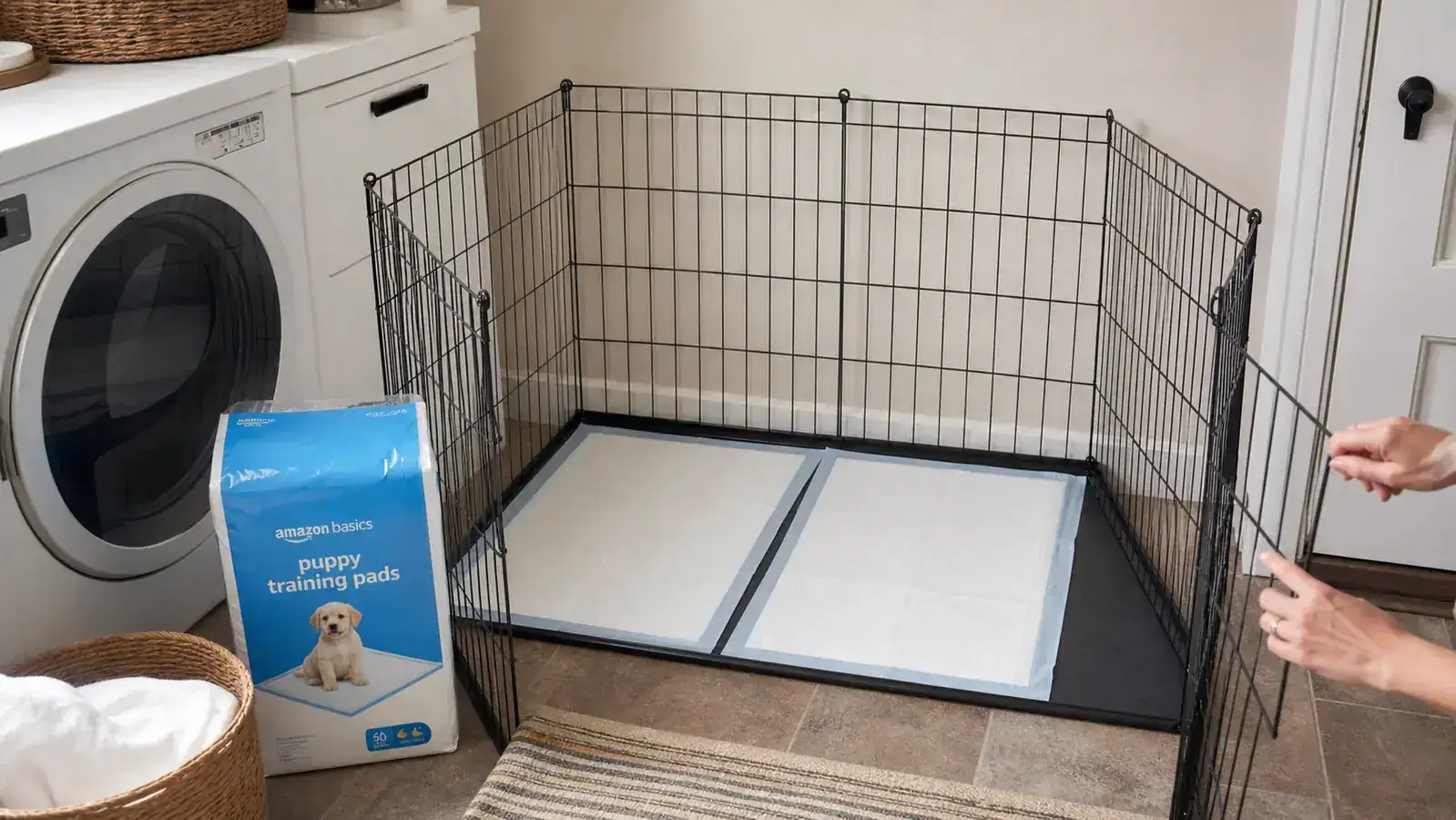
My setup: I started with pads in three spots in the apartment, a wire playpen in the laundry room with two pads covering the floor, one near the back door in the kitchen, and one beside the crate in the bedroom for overnight. By month two, he was reliable enough that I dropped to one pad at night and one near the door. We are now down to a single backup pad by the front door for mornings when he just cannot hold it until we get outside. The number of pads I go through dropped from about 12 to 15 per day in month one to roughly 3 to 4 per day now. That volume drop is not because the pads got worse. It is because training worked.
Total pads used: I stopped counting around 350. I have purchased the 100-count box three times and the 50-count box twice, which puts me somewhere north of 400 pads over the four months.
Absorbency: Does the 5-Layer Construction Actually Matter?
The product description leans on its 5-layer construction, and yes, the layers are visible and functional. The top surface pulls moisture down fast. Within a few seconds of a medium-sized accident, the surface feels close to dry to the touch. That matters for two reasons: a wet surface can cause slipping, and puppies will sometimes stand on the pad mid-accident if the surface is already saturated. The quick-dry top layer addresses both problems.
The absorbent core held up well through the high-volume early weeks. A single pad easily handles two or three normal puppy accidents before needing to be swapped. A genuinely large accident, the kind a puppy produces after drinking a lot of water in a short period, will saturate a single pad fully. That is expected. At Biscuit's current size and bladder output, I plan on one accident per pad and change it out. When he was smaller, I got two or three uses.
I tested one pad to failure, deliberately letting it go through multiple large accidents without swapping. It held six before any leakage appeared at the edge. That is not a use case I recommend in practice, but it tells me the core is genuinely deep and not just marketing copy.
Leak Protection: The Part That Actually Matters for Hardwood Floors
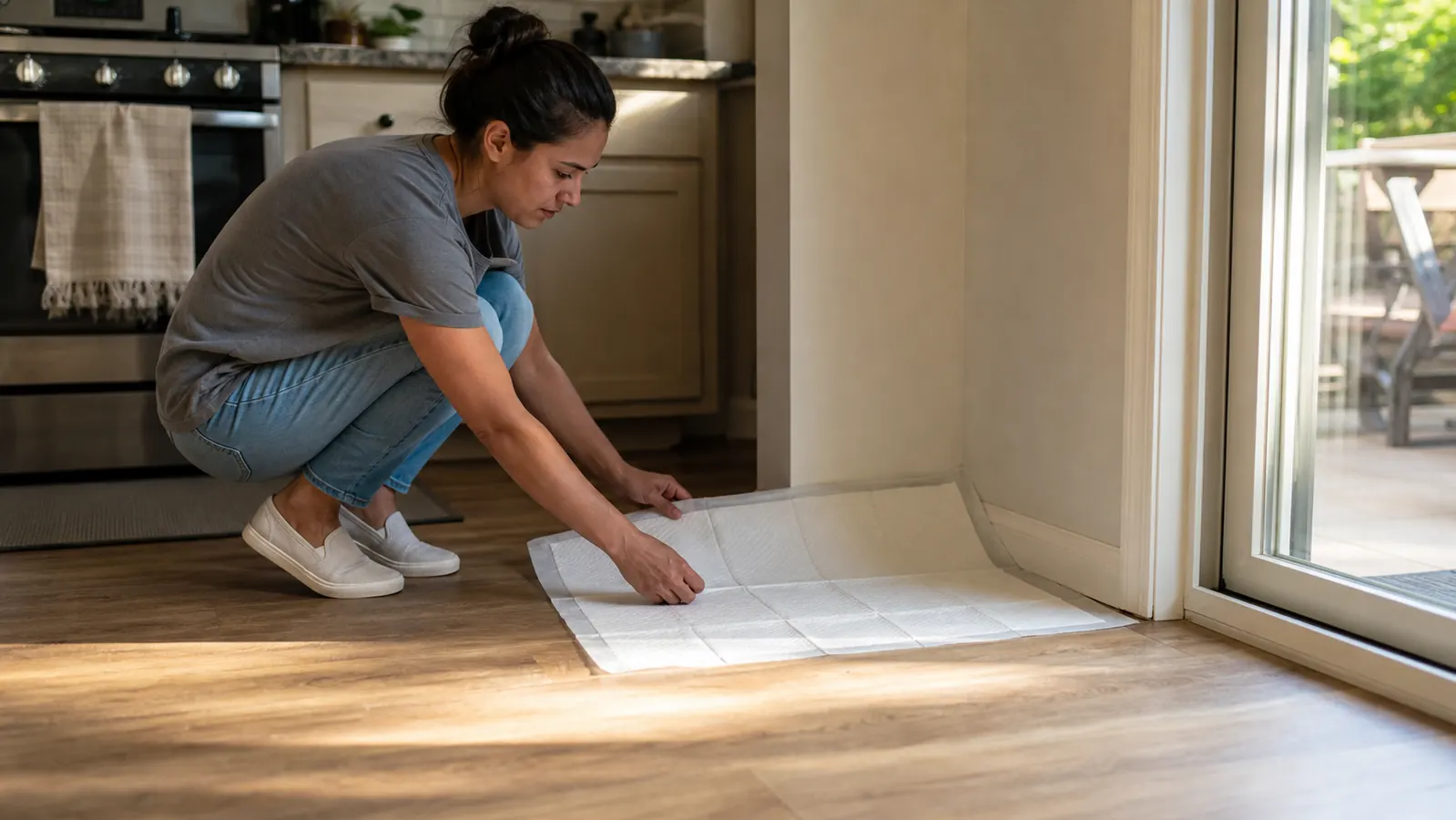
I have hardwood floors throughout my apartment. The whole reason I started with pads at all was to protect them. So the leak-proof base was the feature I cared most about from day one.
In four months, I have had two leak incidents where moisture reached the floor beneath the pad. Both happened in the same scenario: Biscuit decided to do his business at the very edge of the pad rather than in the center, and the liquid ran sideways off the absorbent area before the core could wick it down. One of those times the pad had also been kicked partially out of position before he used it. That is a placement and training issue as much as it is a product issue. When the pads are positioned correctly and the dog uses the pad properly, the leak protection is solid.
The plastic backing is thick enough to feel reassuring when you pick up a used pad. It does not feel like a one-ply grocery bag. I have never had a pad tear on pickup, which is its own category of unpleasant experience I was dreading based on some other brands I tried before landing on these.
In four months of daily use, I had two leak incidents. Both involved edge use or a shifted pad, not a failure of the absorbent core. For hardwood floors, that track record is good enough to keep buying.
Size and Fit: Are the Standard Pads Large Enough?
The regular-size pads measure 22 by 22 inches. Amazon also sells an extra-large version at 28 by 34 inches. I started with the standard size and switched to the XL after month two, when Biscuit got big enough that I noticed him occasionally positioning himself with his back half hanging slightly off the pad.
For a small breed or a puppy under roughly 15 pounds who uses the pad with decent accuracy, the standard 22-by-22 is fine. If your dog is a medium or large breed, or if potty training accuracy is still a work in progress, I would start with the XL and skip the standard size entirely. You will use fewer pads because accidents stay contained, and you will not have the annoying re-learning period when you switch from one size to the other.
The pads lay flat right out of the package. There are no folds that refuse to flatten or corners that curl up, which is a small thing but matters when a puppy is learning what the pad is for. A pad with curled corners reads as a toy or an obstacle, not a target.
Odor Control: Honest Assessment
The pads have a faint floral scent that is meant to attract the puppy to use the pad and also to mask odors. The attractant actually works reasonably well in the first few weeks of training, when you need the puppy to self-select the pad location. By month two, habit had replaced the attractant and it no longer mattered. The floral scent itself fades quickly and was never strong enough to be noticeable more than a foot away.
Odor control after a pad has been used is functional but not impressive. A saturated pad that sits for more than an hour starts to smell. The odor is contained to the area around the pad and does not linger in the room after you remove it, which is all I actually needed. If you are expecting a used pad to be scent-neutral for hours, you will be disappointed. That is not a reasonable expectation for any pad brand at any price point.
My solution was to change pads frequently during high-use periods in the first month. That kept the apartment smelling fine. Once training progressed and accidents dropped, it became a non-issue.
Value Over Four Months: The Math on Cost Per Pad
At the current price, buying the 100-count box works out to a competitive per-pad cost. That is competitive with generic alternatives and cheaper than premium brands like Frisco or Four Paws Wee-Wee Pads by a meaningful margin. The XL version costs more per pad, but still undercuts competitors in that size range.
At peak usage of 12 to 15 pads per day in month one, the math adds up fast regardless of brand. The reason to buy Amazon Basics over a cheaper generic is not really the per-pad price. It is the leak protection and the consistent quality. I tried two other brands during month one when I ran out before a restock. One leaked on the first use. One had such thin absorbent core material that you could feel moisture on the surface immediately. Neither brand had the consistent construction quality I found in the Amazon Basics pads.
For anyone buying in volume, which you will be during active potty training, the consistency matters as much as the price. A pad that fails is worse than a more expensive pad that works, because a failure means cleaning the floor anyway.
What I Liked
- Quick-dry surface keeps the top layer dry after normal-sized accidents
- 5-layer construction genuinely holds up, tested through multiple accidents before any leakage
- Plastic backing is thick and tear-resistant when picking up used pads
- Flat right out of the package, no curling corners
- Cost per pad is competitive, especially in the 100-count box
- Attractant scent helps during early training without being overpowering
- Consistent quality across multiple boxes over four months, no batch-to-batch variation
Where It Falls Short
- Standard 22-by-22 size is marginal for medium and larger breeds, XL is the better starting point
- Edge accidents can bypass the absorbent area if the dog aims for the corner rather than the center
- Odor masking on a saturated pad is functional but not impressive beyond about an hour
- No adhesive strips on the bottom, so an active puppy can scoot the pad out of position
- Plastic backing adds to landfill waste, no compostable option in this product line
Who This Is For
These pads are the right call for anyone in the thick of active puppy potty training, particularly apartment dwellers or anyone without easy, immediate outdoor access. If you are going through 8 to 15 pads a day in the first four to six weeks, the per-pad cost and the consistent quality of these pads will matter to you more than any single premium feature. They are also a solid choice for anyone with hardwood floors or other flooring that does not tolerate moisture, because the leak-proof base is genuinely reliable as long as the pad is positioned well and the dog uses the center. Senior dogs dealing with incontinence are another good fit. The pads are large enough to cover a resting area and absorbent enough for overnight use without leaking through to bedding or floors.
Who Should Skip It
If you have a very large breed dog, a Great Dane or a Mastiff puppy for instance, even the XL size is going to feel cramped once they hit adolescent size. At that point you are better served by a washable pad or a larger-format product specifically designed for big dogs. The same goes if you have a dog who treats any flat object on the floor as either a toy or a bed. Some dogs will drag the pad, fold it, or shred it. That is a training issue, not a product issue, but no disposable pad survives a determined chewer. Finally, if environmental footprint is a top priority, the disposable format is not the right product for you regardless of brand. There are washable training mat options that serve the same absorbency function with far less waste.
For everyone else, particularly the first-time puppy owner staring down weeks of accidents with no idea how many pads they will go through, the Amazon Basics pads are where I would start. They are consistent, they protect floors, and the price-to-performance ratio at volume is hard to beat. See also my head-to-head test in the comparison article if you want to see exactly how these stack up against Best Pet Supplies pads on a pad-by-pad basis.
If potty training is happening right now, stock up before you run out at 11pm on a Tuesday.
Amazon Basics Super Absorbent Puppy Pads are available in several pack sizes. The 100-count box is the best value during high-use potty training weeks. Over 43,000 pet owners agree they are worth stocking in bulk.
Amazon Check Today's Price on Amazon →