
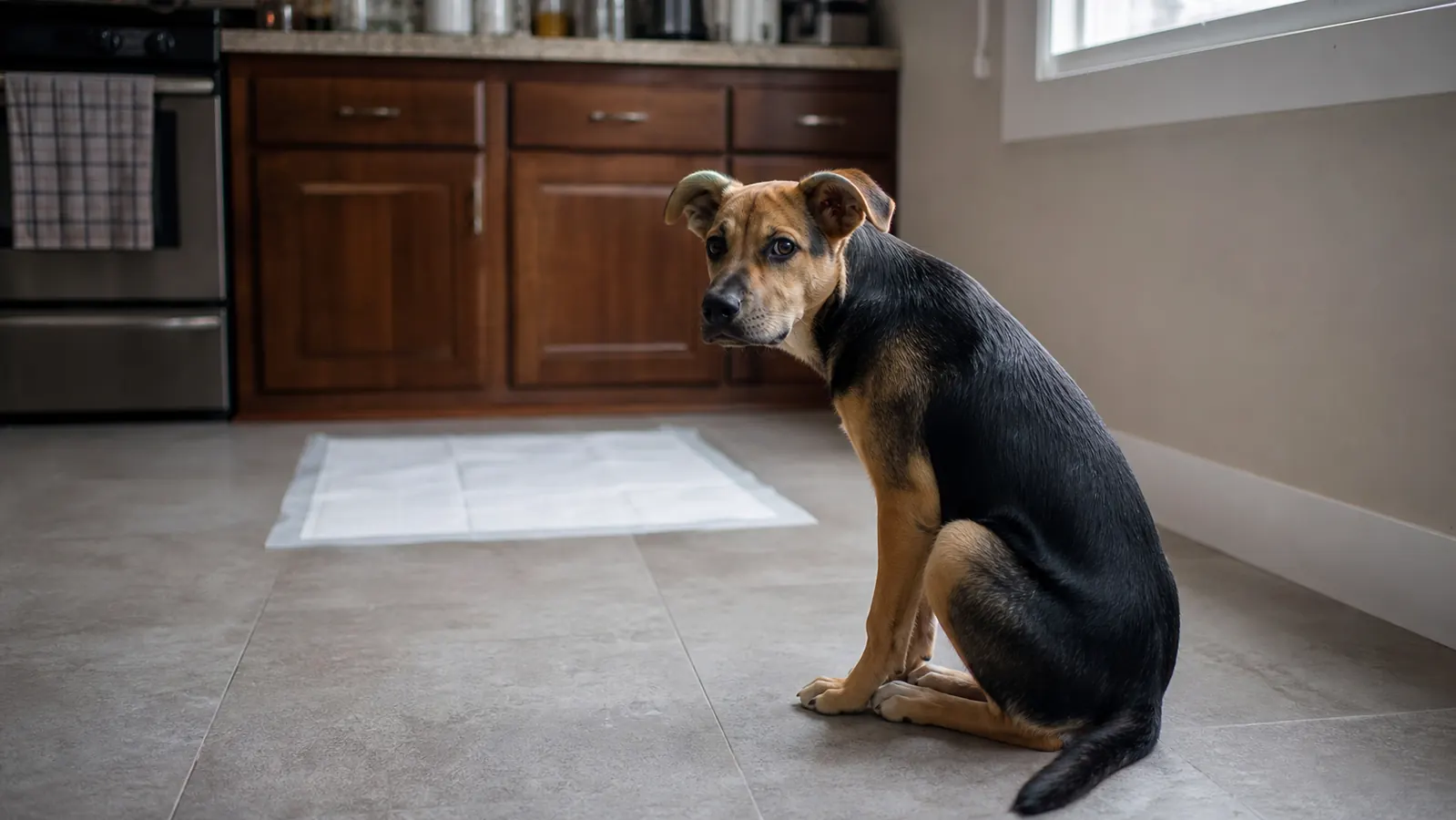
Here is the thing about a 4.6-star average across 43,000 reviews: it tells you that most people who bought this product were satisfied. It does not tell you why the unhappy ones were unhappy, whether those unhappy scenarios apply to your specific dog and your specific floor, or what happens the first time your dog decides the pad looks more like a toy than a toilet. I have owned dogs for fifteen years and fostered eight puppies and adolescent dogs through a local rescue. I have used these Amazon Basics pads on at least four of those fosters, plus my own current dog, a 9-month-old Lab mix named Theo who weighed 34 pounds at the time I started using them. This review is the one I wish existed when I first bought them.
Bottom line first: the Amazon Basics Super Absorbent Puppy Pads are good pads. They are probably the best pads for the price on the market right now. But there are specific situations where they fail, and the star rating buries that. I will walk through the failure modes honestly, tell you exactly when to buy these and when to spend a bit more or buy something completely different, and let you make the call.
The Quick Verdict
Solid absorbency and a genuinely thick leak-proof base. The slipping problem on tile and laminate is real and undersold by reviewers. Not the right pad for shredders or very large breeds, but for a compliant pup on carpet or with a mat underneath, it is hard to beat at this price.
Amazon Check Today's Price →If your dog is not a shredder and your floors are not bare tile, these are probably the right call. Check current price and pack sizes before your next restock.
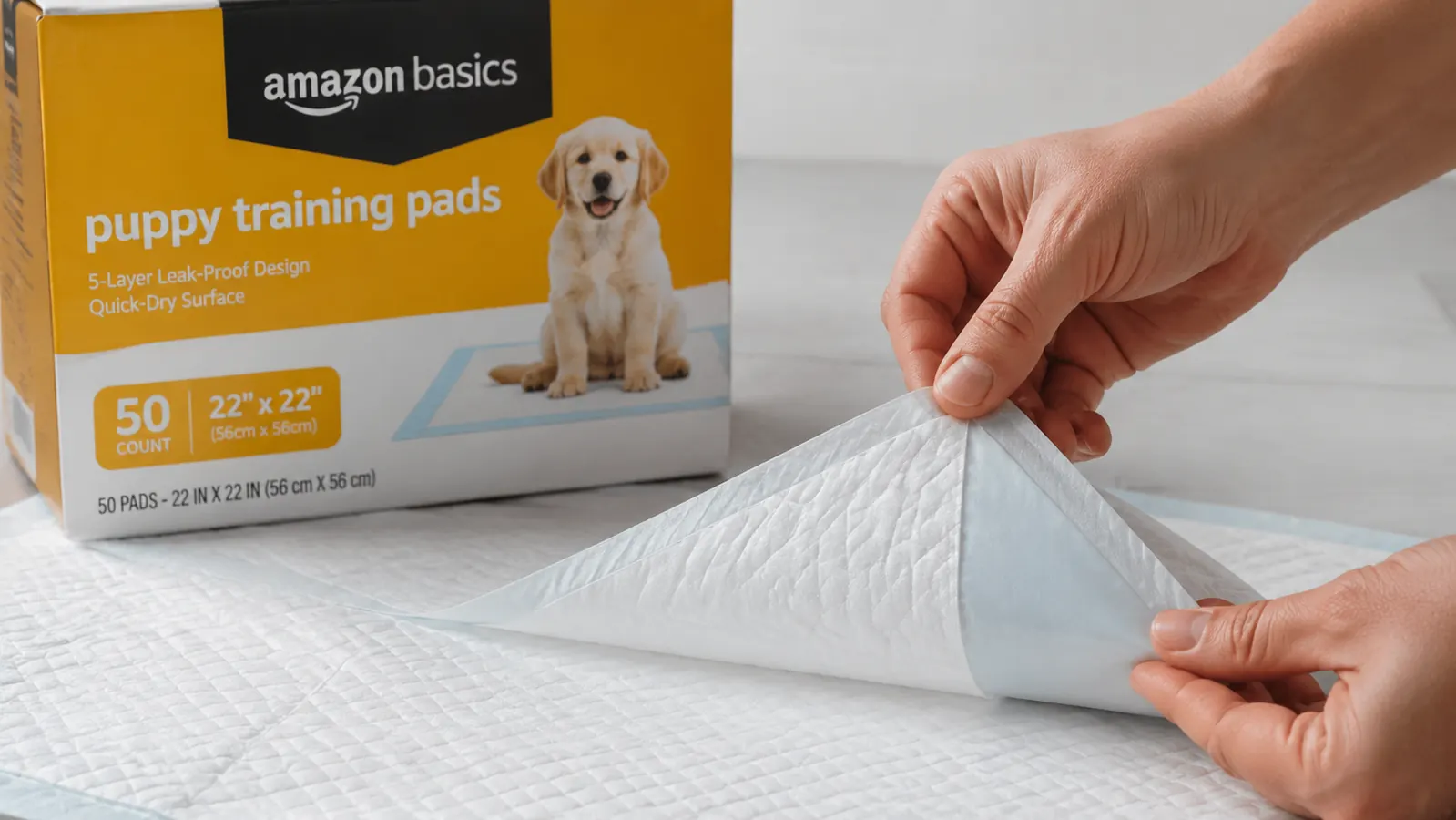
Amazon Basics Super Absorbent Puppy Pads come in standard 22x22 and extra-large 28x34 sizes. The 100-count box is the best value for active training phases. Over 43,000 reviews, 4.6 stars.
Amazon Check Today's Price on Amazon →How I Actually Used These Pads
My testing context matters for what follows. Theo is a mixed Lab who I got from the rescue at six months, undersocialized and with zero house training. He came in at 34 pounds and was already showing early signs of being a destructive chewer when anxious. I have also used these pads with three other fosters in the last two years: a 4-month-old Shepherd mix who shredded the first three pads within a day, a calm Beagle puppy who used them perfectly, and a 7-year-old incontinent Cavalier King Charles whose owner needed something for overnights while she recovered from surgery.
That range of dogs gave me a much more complete picture than any single-puppy review can. The Beagle story is the 4.6-star review. The Shepherd story is the one-star review. The Cavalier story is the quiet five-star review from someone you never see in the comment section because everything worked and they just kept buying. I will cover all three scenarios.
My floor situation: I have a mix of hardwood and tile. The kitchen and bathrooms are tile, the living areas are hardwood. I do not have carpet. That matters because the slipping behavior on tile versus hardwood versus carpet is meaningfully different, and the reviews do not break it down that way.
The Slipping Problem: Why Nobody Warns You About Tile
The plastic backing on these pads is smooth. On carpet, that is irrelevant because the pad grips the fibers and stays put. On hardwood, it moves but not dramatically. On tile or laminate flooring, this pad will slide. The first time Theo stepped onto a pad I had placed on the kitchen tile, the pad shot backward about four inches as he planted his back feet. He spooked, leaped off, and refused to use it for the next 48 hours.
This is not a defect. The pads have no adhesive strips on the bottom, which is a deliberate design choice because adhesive strips can leave residue on floors. But if you have tile or laminate, you need to solve the slipping problem before you expect the dog to use the pad reliably. The fix I landed on: a cheap rubber shelf liner cut to roughly the same size and placed underneath the pad. It adds about 30 seconds of setup and completely solves the problem. But you will not find that tip in the product description.
The same slipping issue applies if a dog approaches the pad fast. Puppies and young dogs do not amble gently onto pads. They trot, they spin, they plop down in a hurry. On hard floors without that rubber mat underneath, a fast-approaching dog can crumple the edge of the pad or slide the whole thing sideways before they have even finished the job. That creates a partially off-target accident, which the review system counts as a pad failure when it is really an installation failure.
The Shredding Problem: Who These Pads Are Not For
The Shepherd mix I fostered, seven-month-old male named Radar, destroyed three of these pads within his first day in my house. He was not malicious. He was anxious and understimulated and anything flat on the floor was a target. He would grab a corner, shake it, and within a minute had opened the pad and spread the absorbent material across a 6-foot radius. Cleanup was worse than any accident would have been.
Here is what I learned from Radar and from conversations with other foster handlers: any dog who shreds, digs, or mouths pad surfaces is not a candidate for disposable pads of any brand. This is not an Amazon Basics problem. This is a category problem. Disposable pads are single-ply consumer products made from polypropylene, fluff pulp, and a thin plastic sheet. No single-use training pad on the market is going to survive a determined chewer. If your dog treats the pad like prey, the correct product is a washable rubber-edged training tray with a replaceable absorbent liner, because the tray structure prevents corner-grabbing. Sending back three boxes of pads and leaving one-star reviews does not change the physics.
Practical test before committing to a large box: put one pad down and watch the dog's first interaction with it. If they sniff and step on, you are fine. If they nose the corner, paw at it, or try to pick it up, stop buying disposable pads and solve the enrichment and training problem first.
The one-star reviews on puppy pads are almost always about the dog, not the pad. A shredder ruins every brand equally. Know your dog before you buy.
What Nobody Tells You About the 5-Layer Construction Claim
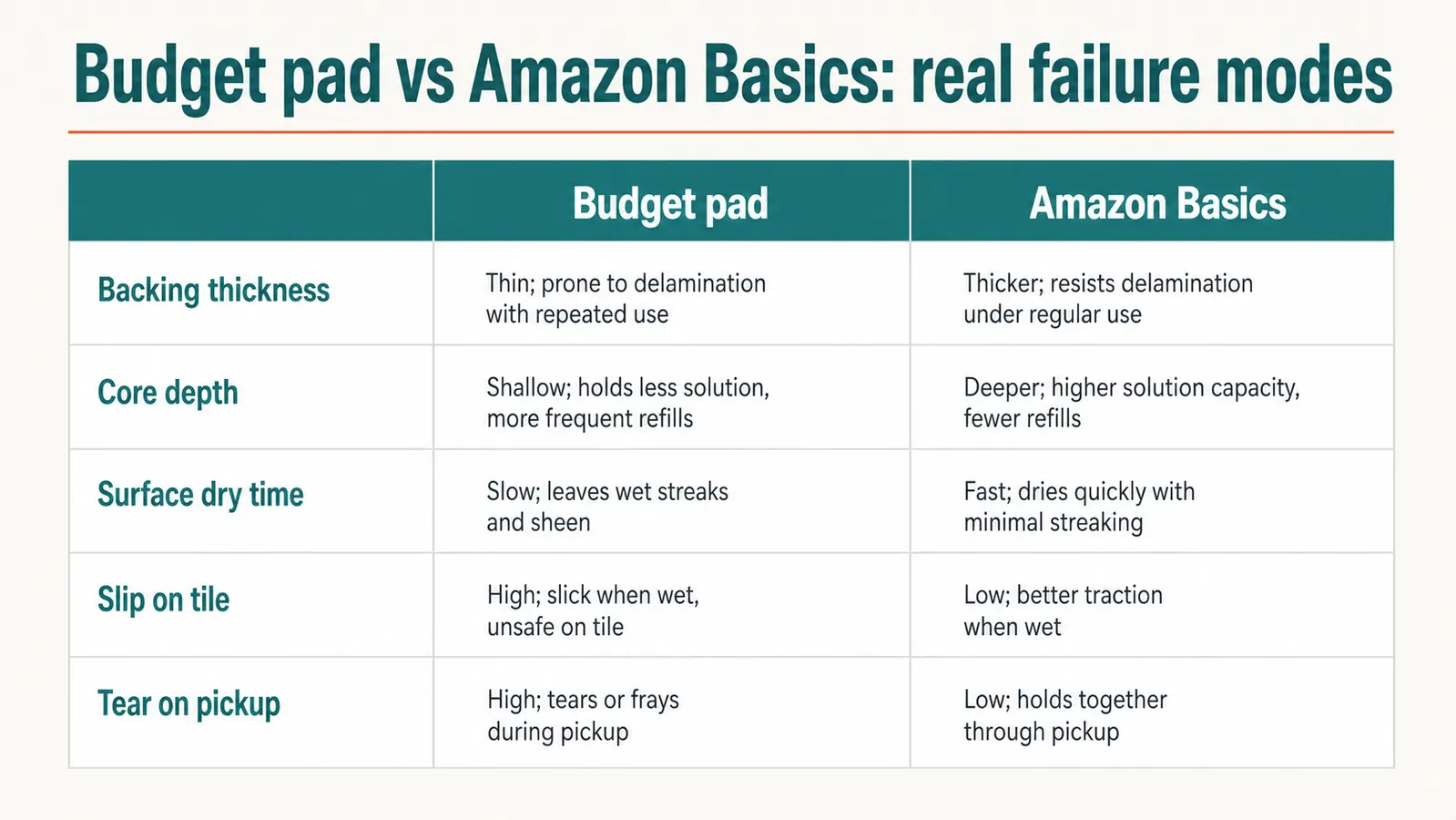
Every mid-range and premium puppy pad now uses the phrase '5-layer construction' in its marketing. Amazon Basics uses it, Frisco uses it, Four Paws uses it. The layers are real, but they are not all the same between brands. What matters is the thickness and density of the absorbent core, which is the third layer down, and the gauge of the plastic backing.
I ran a side-by-side comparison between an Amazon Basics pad and two off-brand pads I bought from an Amazon third-party seller at a lower per-pad price. The difference was immediately visible. The Amazon Basics pad was noticeably thicker when stacked. When I cut open all three, the Amazon Basics absorbent core was roughly twice the depth of either competitor. The plastic backing on one of the off-brands was so thin I could tear it with a single finger. That backing is the only thing standing between an accident and your floor. Saving two cents per pad to get a backing that tears on pickup is not a deal.
The honest takeaway: Amazon Basics is not the absolute cheapest option per pad. It is the cheapest option that actually works. Going below this price point is where the reviews start to describe soaked floors and see-through backing. Going above it to premium brands like Glad for Pets or Fresh Patch adds cost without proportionally improving performance for a typical puppy. The Amazon Basics pads sit at the value-performance crossover. That is why 43,000 people gave it four and five stars.
Odor Blocking: Honest Numbers, Not Marketing Language
The pad has a built-in floral attractant meant to draw the dog toward it and an odor-neutralizing layer meant to reduce smell after use. Both claims are partially true and partially oversold.
The attractant works during early training when the dog has no established habit yet. I noticed Theo sniffing toward the pad placement spot consistently in the first week, which I attribute partly to the attractant. By week three it was irrelevant because habit had taken over. If you are buying these expecting the attractant to do the training work for you, that is not how it functions. It helps marginally in the first days and then fades from relevance.
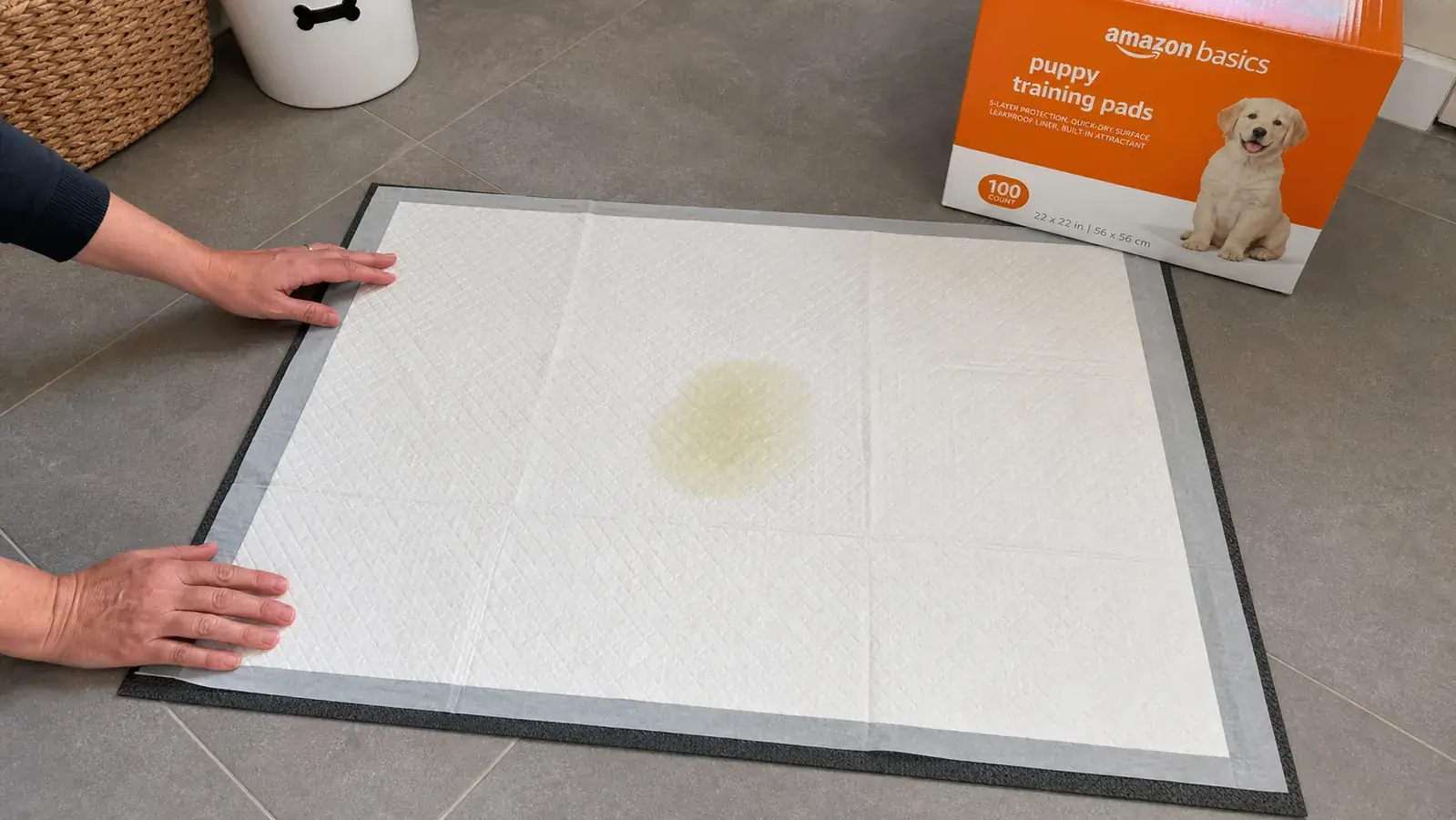
Odor control after use: a fresh accident on a pad smells like urine, because it is urine. The pad absorbs the liquid fast, which reduces surface evaporation and therefore reduces how much the smell spreads through the room. If you change the pad within 30 to 45 minutes, your room does not smell like a dog bathroom. If you leave a saturated pad sitting for two hours or more, it smells. No pad on the market at any price point changes that basic chemistry. The odor control claim on this product means the smell stays localized to the pad rather than spreading across the room, and that part is accurate. It does not mean the used pad is scent-neutral. Manage your expectations and change pads often during high-accident phases.
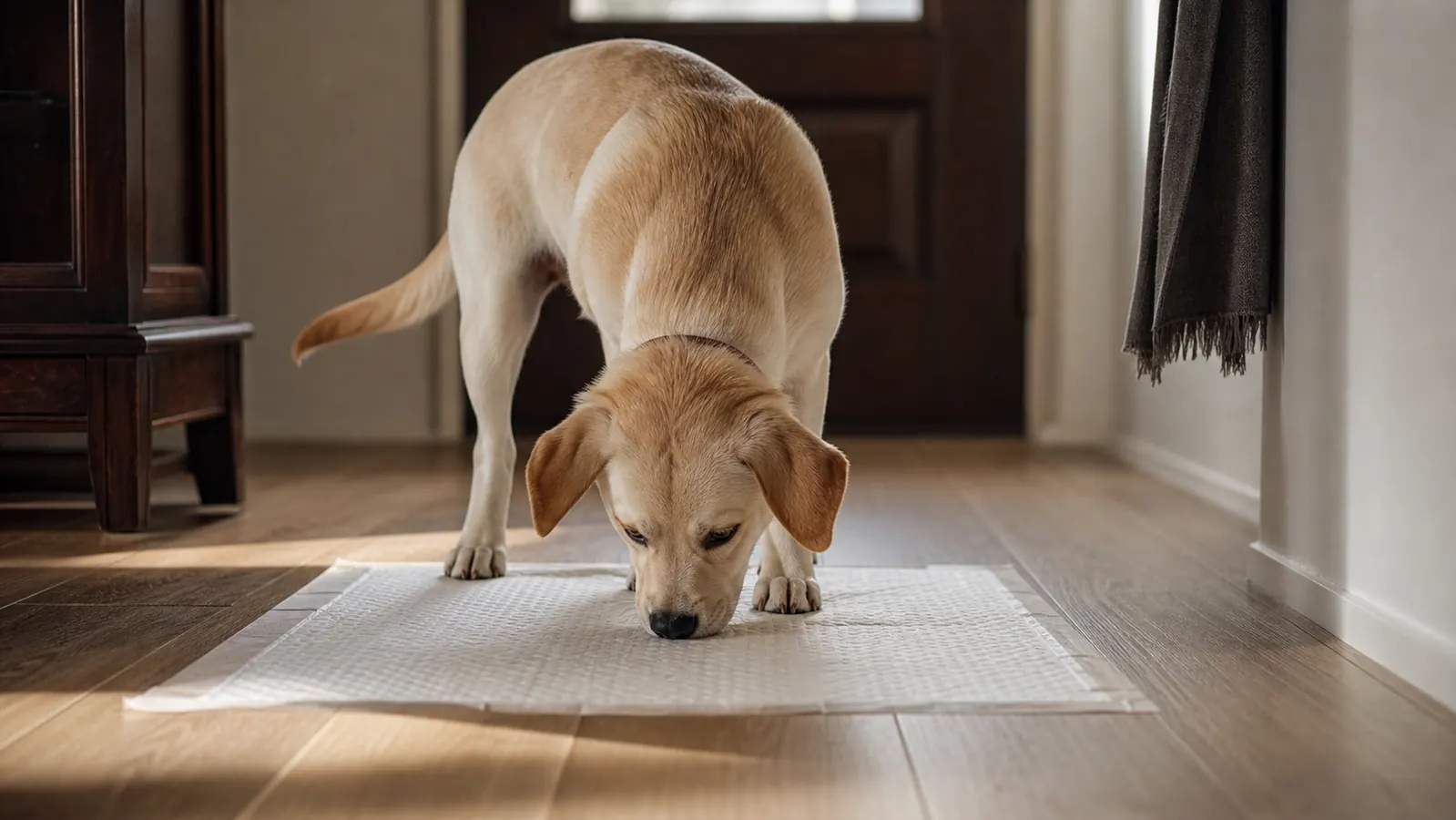
The Incontinent Senior Dog Case: Where These Pads Shine Quietly
The 7-year-old Cavalier I mentioned, Rosie, was my cleanest and most confirming test. Her owner needed pads for overnight because Rosie had developed age-related urinary incontinence after a spinal procedure. She was not being trained. She simply needed a soft, absorbent surface she could walk to at 3am without leaking onto hardwood floors.
I put down an XL pad next to her dog bed each night. In two weeks of use, I had zero floor accidents. Rosie is small enough that her accidents, which are medium-volume because of the incontinence medication she takes, never overwhelmed the pad. The surface stayed dry enough that she would step on the pad without hesitation, which matters a lot with senior dogs who have arthritic hesitation about stepping on uncertain surfaces. The quick-dry top layer earns its keep in this use case more than in the puppy scenario, because a senior dog who feels wet material underfoot will often stop using the pad.
For senior dog incontinence, this is a genuinely excellent product. The pad size, the absorbency, and the quick-dry surface all match what an incontinent dog needs better than most alternatives I have used.
What I Liked
- Absorbent core is noticeably thicker than budget alternatives at this price point
- Quick-dry surface keeps the top layer tactilely dry after a normal accident, important for dogs who stop using wet surfaces
- Plastic backing is thick enough to pick up a saturated pad without tearing
- Pads lie flat straight out of the package with no corner curl
- Effective in the incontinence use case for senior dogs, not just puppy training
- Built-in attractant provides a genuine early-training nudge in the first week or two
- Consistent quality between batches and boxes over extended use
Where It Falls Short
- No adhesive or grip on the bottom, slides on tile and laminate without a rubber mat underneath
- Not suitable for dogs who shred, dig, or mouth pad surfaces, no disposable pad is
- Odor control keeps smell localized but does not eliminate it on saturated pads left over 45 minutes
- Standard 22x22 size is too small for medium breeds once they hit 20 to 25 pounds
- The XL version costs meaningfully more per pad, may shift the value calculation for high-volume users
- Disposable format generates significant waste with no compostable option in the line
Who This Is For
If you are training a puppy who is not a confirmed shredder, and your floors are either carpet or you are willing to put a rubber mat underneath on hard floors, these pads are the correct buy. They hit the crossover point where the absorbency and build quality are genuinely reliable and the per-pad price does not make bulk purchasing painful. The same goes for apartment dwellers without outdoor access who need reliable floor coverage for frequent small accidents. Senior dogs with incontinence issues are another strong fit, particularly for the XL size used as an overnight station. If you need pads and you do not have a specific reason to go up to premium or down to budget (where backing failures start appearing), this is the sweet spot.
Who Should Skip It
Skip disposable pads entirely if your dog shreds, digs at flat surfaces, or picks up pad corners. No single-use training pad survives that behavior. Look at washable training trays with rubber surrounds instead. Skip the standard 22x22 size if your dog is already over 20 pounds or is a large breed puppy, because you will exhaust the absorbent area too fast and edge accidents will be a constant problem. Also reconsider this product if your floor is bare tile with no plan to add a mat underneath. The slipping problem is real, the fix is easy, but if you want to skip the workaround entirely, look for pads with adhesive corner tabs, a different product category entirely. And if environmental waste is a genuine priority for you, the correct answer is a washable absorbent mat, not a slightly greener disposable pad. The washable category is a completely different comparison and worth its own article.
For most people with a new puppy or an incontinent older dog, though, these pads are the practical, affordable choice that the 43,000 reviews correctly identify. The star rating is right. You just need to know what it is rating. See also how these compare directly with Best Pet Supplies pads in our side-by-side absorbency breakdown, and the full step-by-step guide on how to use pads correctly during potty training to avoid the placement and consistency mistakes that generate most of the one-star outcomes.
If your dog is not a shredder and you just need reliable leak protection without overpaying, this is the pad to stock up on.
Amazon Basics Super Absorbent Puppy Pads. 5-layer construction with quick-dry surface, thick leak-proof backing, and consistent quality across boxes. Available in standard and XL sizes. Check current pack pricing before your next restock.
Amazon Check Today's Price on Amazon →